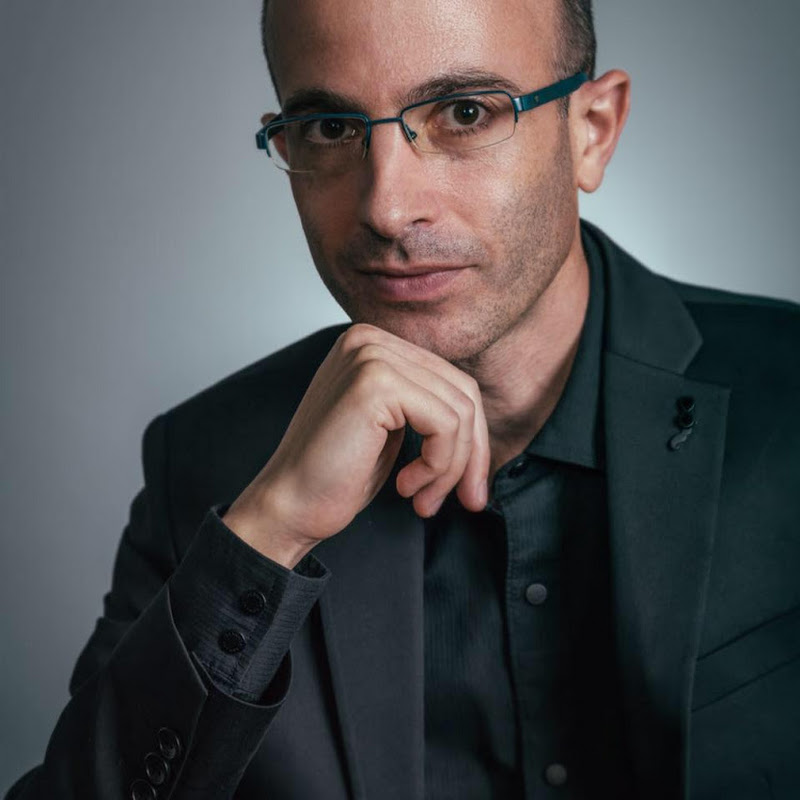
Yuval Noah Harari
Area of Focus
Yuval Noah Harari is a historian and public intellectual who focuses on the long-term future of humanity, specifically the impact of artificial intelligence, biotechnology, and information networks on human evolution and society.
Born
He was born in 1976 in Haifa, Israel.
Citizenship
He is a citizen of Israel.
Education
Harari received a B.A. in history and international relations from the Hebrew University of Jerusalem and a D.Phil. in history from the University of Oxford.
Occupations
He is a professor of history at the Hebrew University of Jerusalem and a popular science author.
Career & Projects
Harari has authored several influential books examining the trajectory of human history and the future, including "Sapiens: A Brief History of Humankind," "Homo Deus: A Brief History of Tomorrow," and "Nexus: A Brief History of Information Networks from the Stone Age to AI." His work explores themes of consciousness, intelligence, and the potential for technological revolutions to fundamentally alter the human species.
Currently, he continues to write and speak on the implications of the Fourth Industrial Revolution, machine learning, and bioengineering. His recent projects include the "Sapiens: A Graphic History" series and the "Unstoppable Us" series for younger readers, which aim to communicate his historical and futurological perspectives to broader audiences.
Vision for the Future
Harari predicts that humanity is on the verge of its greatest revolution, driven by the combination of machine learning and biotechnology. He suggests that science is likely to usher in an era of inorganic life shaped by intelligent design, potentially leading to the engineering of new life forms such as cyborgs and super-humans. He has stated that "Homo sapiens as we know them will disappear in a century or so."
He warns that these new powers may not be shared equally, potentially dividing humanity into a super-elite of improved humans and a mass of "useless people." He emphasizes that power will increasingly reside with those who control the algorithms, and he advocates for critical thinking regarding the monopolization of these technologies by a small number of countries.